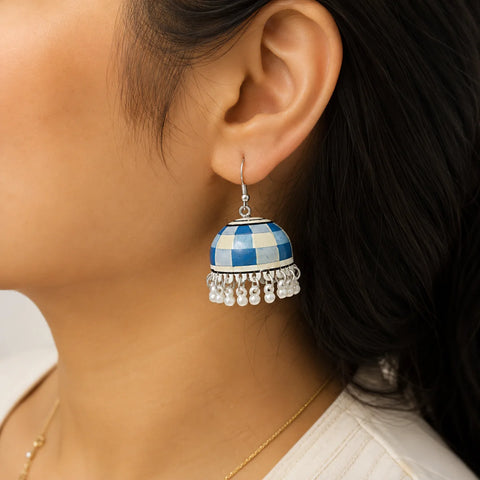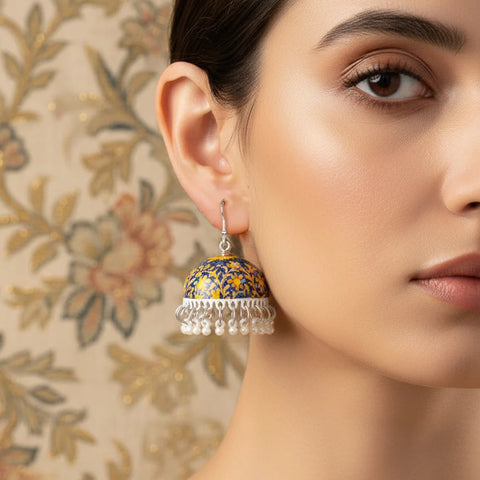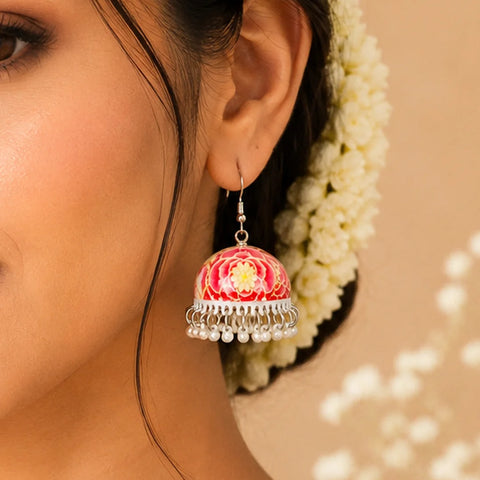


What is Meenakari? It is the art of decorating metal jewellery with coloured enamel to create intricate patterns and vibrant finishes. The craft has deep Persian and Mughal connections and became particularly associated with Jaipur and Rajasthan in India. Today, Meenakari earrings and jhumkas bring this traditional artistry into contemporary ethnic jewelery styling.
Meenakari jewellery brings colour, craftsmanship and traditional Indian design together in a way that still feels remarkably versatile. From colourful floral details to pearl-edged jhumkas, these pieces can complement everything from a saree to a simple contemporary outfit. But there is more to this craft than its beautiful colours. Here is where Meenakari comes from, how it is made, how to care for it, and how to style it today.
What Is Meenakari Jewellery?
At its simplest, it is a form of enamelling in which coloured material is fused onto a metal surface to create decorative designs. Traditional Meenakari is known for vivid colours, intricate patterns and motifs inspired by flowers, birds, geometric forms and other elements of Indian decorative art.
The technique has traditionally been used on metals such as gold and silver, while contemporary jewellery can use other metal bases as well. The enamel gives the surface its characteristic colour and glossy decorative appearance.
The appeal of Meenakari earrings comes from this combination of traditional craftsmanship and expressive colour. A single pair can add detail to an otherwise minimal outfit, while an elaborate jhumka can become the focal point of a festive look.
Where Does Meenakari Jewellery Come From?
The history of Meenakari is connected to the long tradition of enamelling in Persia. The craft later travelled into the Indian subcontinent and developed within Mughal and Rajput jewellery traditions. In Rajasthan, Jaipur became one of the most important centres for Meenakari craftsmanship.
Rajasthan's official handicraft resources trace the establishment of Meenakari in Jaipur to Raja Man Singh of Amber, who brought skilled enamellers from Lahore and helped establish Jaipur as a centre for the craft around the turn of the 16th century.
Over time, Indian artisans developed their own approaches to colour, motifs and jewellery design. Jaipur remains particularly associated with the craft, and Rajasthan is still recognised for its Meenakari and Kundan jewellery traditions.
This history is part of what makes Meenakari jewellery more than simply colourful fashion jewellery. Its visual language carries centuries of craftsmanship and cultural exchange.
How Is Meenakari Jewellery Made?
Making Meenakari jewellery involves several carefully controlled stages. Traditional craftsmanship requires precision because the enamel has to sit correctly within the prepared design and withstand the firing process.
1. Preparing the Metal
The jewellery begins with a shaped metal base. Traditional Meenakari has been worked on gold and silver, while different forms of contemporary jewellery may use other metals.
2. Engraving the Design
The surface is engraved with the desired pattern. These grooves create spaces that can hold the enamel. Traditional designs can feature flowers, birds, leaves, geometric patterns and other decorative motifs.
3. Adding the Enamel
Coloured enamel is placed into the prepared areas. The colours are selected according to the desired design and the characteristics of the base material.
4. Firing the Piece
Heat is used to fuse the enamel to the metal. Traditional Meenakari involves repeated firing, with different colours requiring careful handling during the process.
5. Polishing and Finishing
Once the enamel work is complete, the piece is cooled and polished to reveal the finished surface. The result is a vibrant decorative finish that gives Meenakari earrings their distinctive visual character.
Why Are Meenakari Earrings So Popular?
Meenakari earrings combine the visual richness of traditional Indian traditional jewellery with the ease of styling an individual accessory. They can introduce colour without requiring a complete jewellery set.
Jhumkas are especially popular because their rounded, bell-like silhouette works naturally with detailed enamel designs. Pearl drops, beads, floral patterns and contrasting colours can add movement and dimension to the traditional shape.
At Discov Accessories, the Meenakari collection includes colourful floral bell jhumkas, dome styles, pearl-detailed designs and other variations that bring the traditional aesthetic into contemporary wardrobes.
How to Style Meenakari Jhumkas
One of the easiest ways to wear Meenakari jewellery today is to treat the earrings as the main statement piece. The colourful detailing can do much of the styling work on its own.
With a Saree
Pair colourful Meenakari jhumkas with a silk, cotton or printed saree for a traditional look. Choose earrings that either complement one of the saree's colours or deliberately contrast with it.
For a simpler saree, a detailed jhumka can add visual interest. With a heavily embellished saree, a more streamlined pair can keep the overall look balanced.
With a Kurta or Anarkali
Meenakari jhumkas naturally complement kurtas, Anarkalis and other Indian silhouettes. Match the dominant colour of the earrings with a dupatta, embroidery detail or another small element of the outfit rather than trying to match every colour exactly.
With Indo-Western Outfits
You do not need to reserve Meenakari earrings for traditional clothing. Pair a colourful jhumka with a solid-coloured dress, blouse, top or contemporary co-ord to create a contrast between traditional jewellery and modern clothing.
With Minimal Outfits
A simple monochrome outfit creates an ideal canvas for colourful Meenakari. A floral or multicoloured jhumka can become the focal point without the need for a necklace or multiple accessories.
Let the Jhumkas Lead
When your earrings feature several colours, pearls or elaborate detailing, keep the rest of your accessories relatively understated. This allows the craftsmanship and colour of the jhumkas to stand out.
How to Choose the Right Meenakari Earrings
Choosing the right pair depends on the occasion, outfit and amount of visual detail you prefer.
Consider these factors:
-
Size: Smaller styles work well for everyday outfits, while larger jhumkas create a stronger statement.
-
Colour: Choose complementary shades for a coordinated look or contrasting colours when you want the earrings to stand out.
-
Design: Floral, geometric, pearl and beaded details create different visual effects.
-
Occasion: Simple designs can suit everyday dressing, while elaborate styles work particularly well with festive and wedding outfits.
-
Outfit: If your clothing is heavily patterned, consider a simpler pair. If your outfit is understated, a colourful jhumka can add the finishing touch.
Discov's current collection includes floral bell jhumkas, colourful beaded styles, pearl-accented designs and other variations, making it easier to choose according to your preferred colour and silhouette. Explore types of earrings to discover popular designs, styles, and materials that complement different outfits and occasions.
How to Care for Meenakari Jewellery
Good care helps preserve both the finish of the jewellery and the delicate decorative details.
Follow these simple practices:
-
Wipe the jewellery gently with a soft, dry cloth after wearing it.
-
Store each piece separately in a soft pouch or dry jewellery box.
-
Keep it away from water and excessive moisture.
-
Avoid direct contact with perfume and other chemicals.
-
Do not use abrasive cleaners or rough cloths.
-
Handle detailed jhumkas carefully to avoid scratching or damaging decorative elements.
Discov's jewellery care guidance recommends gentle handling, dry-cloth cleaning, separate storage and keeping accessories away from water, perfume and other chemicals. Explore latest fashion trends for women to discover popular outfits, trending colours, modern silhouettes, and stylish looks for everyday wear, work, parties, and special occasions.
Is Meenakari Jewellery Suitable for Everyday Wear?
Yes, Meenakari jewellery can be worn for everyday occasions when you choose a comfortable, appropriately sized design and care for it properly.
For everyday styling, consider smaller or lighter-looking jhumkas with simpler detailing. Save larger, more elaborate designs for festive occasions, celebrations or weddings when you want the earrings to make a stronger statement.
The key is to choose the design according to your outfit and comfort rather than treating Meenakari as jewellery reserved only for traditional occasions.
Can You Wear Meenakari Jhumkas With Western Outfits?
Yes. Meenakari earrings can work particularly well with western outfits when the clothing has a simple silhouette or solid colour.
Try a colourful jhumka with:
-
A plain black or white dress
-
A solid-coloured blouse
-
A simple top and trousers
-
A contemporary co-ord
-
A minimal evening outfit
The contrast between a traditional Indian jewellery form and modern clothing can make the overall look feel intentional rather than overly traditional.
What Makes Meenakari Jhumkas Different?
The defining feature is the use of coloured enamel as part of the jewellery's decorative design. Unlike plain metal jhumkas, Meenakari styles use colour, pattern and enamel detailing to create additional visual depth.
That makes each pair more expressive. A red floral jhumka can create a festive mood, while an ivory-and-gold design can feel more understated. A geometric Meenakari style can also bring a contemporary edge to the traditional jhumka silhouette.
Why Add Meenakari Earrings to Your Jewellery Collection?
Meenakari earrings offer versatility without losing their traditional character. They can be worn with ethnic clothing, paired with contemporary outfits or used as a colourful accent when the rest of your look is minimal.
They are also easy to style around one central idea: let colour do the talking.
If your wardrobe includes sarees, kurtas and festive outfits, a traditional jhumka can complement those pieces naturally. If your personal style is more contemporary, choose a geometric, monochrome or subtly coloured design and pair it with a modern silhouette.
For a wider selection, explore Discov Accessories' Meenakari collection and discover floral, colourful, pearl-detailed and contemporary jhumka styles. You can also explore the Traditional collection for more Indian-inspired jewellery designs.
Discover Meenakari Jewellery at Discov Accessories
Traditional craftsmanship does not have to mean traditional styling. Meenakari earrings can bring colour to a festive saree, character to a simple kurta or a striking contrast to a modern outfit.
Explore Discov Accessories' Meenakari collection for colourful bell jhumkas, floral designs, pearl-detailed styles and more. For more heritage-inspired pieces, browse the Traditional collection and find jewellery that lets timeless Indian design work effortlessly with your personal style.
Frequently Asked Questions
Q1. What is Meenakari jewellery?
Meenakari jewellery is metal jewellery decorated with coloured enamel. The enamel is fused onto the metal to create intricate patterns, vibrant colours and decorative finishes.
Q2. How is Meenakari jewellery made?
The metal is shaped and engraved, enamel is added to the prepared areas, and the piece is fired to fuse the enamel with the metal before being cooled and polished.
Q3. Can Meenakari jhumkas be worn with western outfits?
Yes. Colourful jhumkas can complement simple dresses, tops, blouses and other contemporary outfits, particularly when the clothing has a clean or solid-colour design.
Q4. Is Meenakari jewellery suitable for everyday wear?
Yes. Simpler and lighter designs can work well for everyday styling, while larger and more elaborate pieces are better suited to festive occasions.
Q5. Will water damage Meenakari jewellery?
Water and moisture should be avoided as part of regular jewellery care. Keep Meenakari pieces dry and away from perfume and other chemicals to help maintain their finish.
Q6. What should I wear with Meenakari earrings?
They pair well with sarees, kurtas, Anarkalis, festive outfits and simple western silhouettes. Match or contrast the colours depending on the look you want to create.
Q7. Why are Meenakari jhumkas popular?
Their combination of the traditional jhumka silhouette, vibrant enamel colours and intricate decorative details makes them versatile for both ethnic and contemporary styling.
Q8. Why is Jaipur associated with Meenakari?
Jaipur became a major centre for Meenakari in Rajasthan after skilled enamellers were brought from Lahore during the Mughal period. The craft subsequently developed into an important part of Jaipur's jewellery tradition.